Sunday, November 3, 2013

Happy Worship Your Dog Day. Where's the Shampoo?


If you were a dog and it was your festival day, wouldn't you start it by having a nice roll in a big steaming pile of fetid food rot and composted poo mush and unidentified green stench? If my dog had a Facebook page, her status update would say, "I stink!"

It would also say, "Happy Kukur Tihar, all my dog friends. Weren't you impressed today with how nicely I stank? Is there a better way to celebrate a day on which we, the dogs of Nepal, are worshiped for our essential dogginess?"

Kathmandu is full of dogs. In addition to households dogs, there are an estimated 20,000 dogs living on the street. Those aren't strays, which implies they strayed from somewhere. They're born and live on the street, though many do adopt a house (or a meat shop or a temple where people offer food to the gods) and hang out around it, patrolling it and hopefully getting tossed scraps for their trouble.

Our dog Sandy began life as one of them. She was born on the streets and followed our son home in iconic fashion as a small pup, about three weeks after we'd moved to Nepal. Actually he'd gone out to do "homeschool Animal Science research" (translation: feed a pack of dogs), and discovered in his research that if you feed dogs, they'll all follow you home in a wagging shoving mob. Sandy, always adventurous, was first to venture through the gate. She's a classic Indian Pariah Dog, a dingo-like critter with a curly tail, barrel chest and a vocal range that sounds like singing. The local dogs of South Asia are landrace or "primitive dogs," which means they're not formal breeds but self-selected survivors of the earliest types of dogs, much as you might have seen in Pompeii or Ancient Egypt.
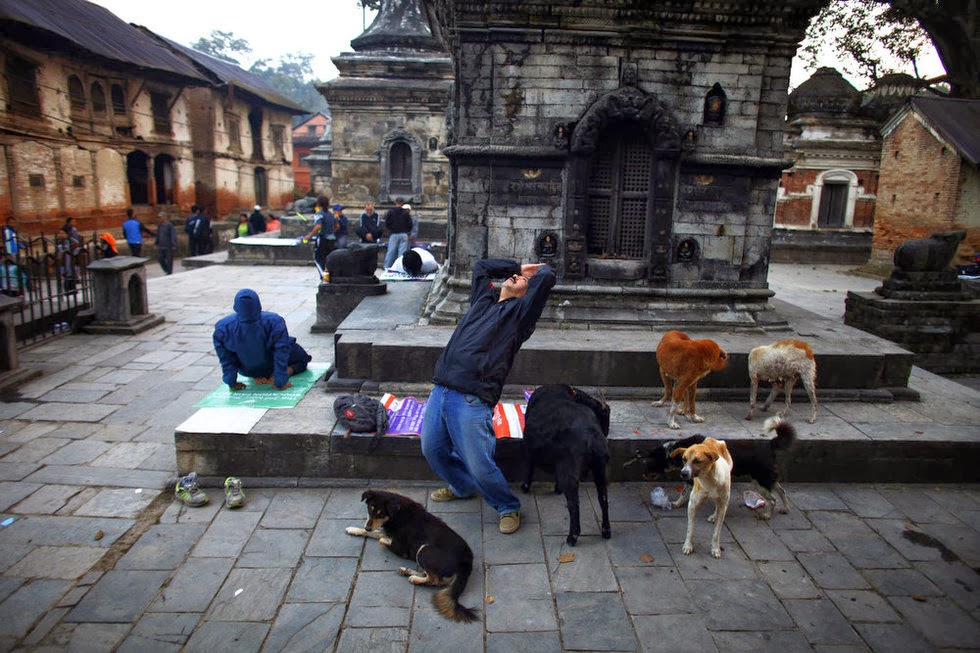

This guy is either doing his morning exercise or yawning after a sleepness night filled with dog barking

The status of dogs in Nepal can sometimes be quite sad. That's true for owned dogs as well as street dogs, sometimes more so, because at least street dogs are free while owned dogs are often chained all day. Below is a street dog (though I've seen owned dogs that skinny), now cared for at Animal Nepal, an animal welfare non-profit where my son volunteers. Further north, good work is done by KAT Centre (Kathmandu Animal Treatment Centre)


But every year the dogs of Nepal are king and queen for a day, when well-loved companions and chained guard dogs and street dogs alike are feted with food, garlands and prayer. I'm sure there are various explanations out there in WebLand, but what people really say when you ask "why do you worship dogs?" is pretty simple: They're the best friends of people. It's often said that dogs become people in their next lives. So you can think of them as Almost People.

In conversation, people tend to connect the dog festival to a beautiful story about the great warrior Yudhisthira, who after his victory in the epic Trojan War-like battles of the Mahabharata made the arduous journey over the Himalayas to the home of the gods, accompanied by his dog and his brothers. During the journey, his brothers proved to be good guys but not that good, and Hindus come down on the Works side of the Faith vs. Works debate, so the good-but-flawed brothers died along the way, like this:


When Yudhisthira finally got to heaven, only he and his dog were left. They were met at the gates by Indra, the god of rain and thunder. "What do you mean, coming to our home with this dog? You can't enter heaven unless you give up your darned dog."

"No," said the brave Yudhisthira, "my dog has been loyal to me, so I have to be loyal to him. I guess I'll go ... wherever I go if I don't get into heaven. Back for another round on the wheel."

And then Indra revealed that it had all been a test, and he had passed. The dog, in fact, was actually Yudhisthira's own father, Dharma, who had been with him all along.

Notice the curly tail on Yudhisthira's dog (a.k.a Dad in Disguise.) Curled tails are such a common feature on South Asian dogs that the letter рдв (dha) is memorized in school with the chant "kukur puchhure dha," or "dog-tailed dha," because it curls like a dog's tail.

Back to Almost Heaven, Kathmandu, where the dogs have been having their festival. If you live here, you're probably thinking, "What, don't they have a festival every day? What else could all that barking be?" Because the sound of Kathmandu at night goes like this:


silence ... somebody hawking and spitting on the street ... BARK? BARK! BARK BARK yip yip WHOOF ME TOO BARK ME TOO ME TOO .......... silence ......... silence ............. BARK? BARK. BARK! bark bark BARK BARK BARK BARK BARK!


The 20,000 voices of Dogmandu. If you come to Nepal, it helps to either appreciate dogs in harmony or have a quick exit plan.

I'm in the Appreciating camp. One of the coolest aspects of daily life here is the chance to observe dogs in a more natural setting than the First World, where they're Well-Bred and Properly Regulated and stay inside glued to their TVs and don't get to roam and interact freely, so that even observers like Alexandra Horowitz, the author of the fascinating Inside of a Dog: What Dogs See, Smell and Know, have to draw conclusions about dog-to-dog interactions by going to a dog park. That's like trying to figure out people by observing them at cocktail parties with their bosses present.

On my daily walks with Sandy, I've learned the territories of the local dogs, can see how they form alliances, and watch the interplay of personality and status. Sandy is an amiable type, always game for fun; after all, she was first through the gate as a pup (which worked out well for her personally, though not so much from a perpetuation-of-the-genes standpoint, since she got "fixed.") She seems to be a "leader" without being alpha; perhaps dogs, like people, can be taken as leaders in part because they're just nice and fun. Sandy tends to run at the head of a pack with other dogs following, but she's also very quick to roll on her back and show her belly. So leadership isn't all about toughness.

This is how she spent her Annual Day to be Worshiped. The day began as always, by meeting up in our yard with her BFF Khoire, the dog-that-adopted-our-landlady's-house. Her name means "brownie" or "mangy," depending on pronunciation. She's blind in one eye, and it took her about three months to come close to me, and even longer to warm up to Sandy. They had a big fight and Sandy still has a scar from it and now they love each other. Also Khoire is now addicted to belly rubs.
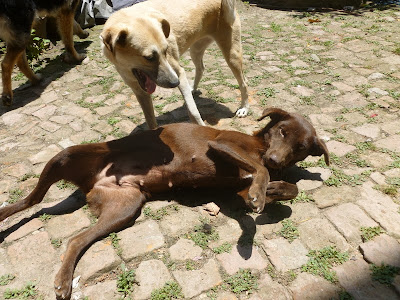

Then off to the wall across the lane to meet Saibo. He has another name, too: Chocolate-y. When "Saibo" doesn't work to call him, they resort to "Chocolate-y." Nepali dogs are great at climbing walls. This is Saibo a.k.a. Chocolate-y on his wall,  displaying the classic Pariah Dog pointy ears and, of course, a lovely malla (flower garland) and tika (vermilion powder) because he has already been worshiped. Even his paws are powdered.


Hey Khoire and Saibo. Come on down and play. Oh I love you guys, you are my very best friends!


Harumph. I'm here too. Behind the wall. I act like I live here in Saibo's nice yard, but actually I'm just a big macho bruiser and go where I please. And where I please is Saibo's yard. He isn't as big as me, so he doesn't disagree. And somebody worshiped me today, too, because they'd better. I've got an agreement with Saibo -- you don't kick me out, I don't beat you up, and also I won't tell other dogs you're called "Chocolate-y" -- and I'm OK with dames like Sandy, although somehow she never comes into heat. What's up with that? That Valuable German Shepherd at Sandy's house came into heat and the owners locked her in a cage but I GOT IN and they found me in the cage with her in the morning, bwahaha. So the gals are OK. And Saibo, because he knows his place. Which is mine now. But I HATE Sisumanu from down the lane. Do not come into my turf, Sisumanu. 


Here comes Sisumanu, to play with Sandy and Khoire. Better watch out for Nameless Bruiser.


Hmmm. This looks like a nice place. Lots of trash around. 


Hey, I've got a great idea. This is WAY more fun than something Nameless Bruiser would come up with. Let's make a mad dash for the other side of the field here ...


... and roll in a STINKY COMPOST HEAP that makes us smell like fetid puke!

Of which I have no pictures. Because I was too busy blocking my nose. A stinky dog covered with green slime is all the more exciting on a day when there is no water in the house, because it's Kathmandu and there is often no water, so it was shampoo + a single bucket of water dribbles + many non-worshipful comments.
So my advice to dogs is this: Watch out for that whole plan about becoming a human in your next life. You might get your wish. And then, someday, you'll be cleaning rot-scented green slime off a dog when there's no water. See how you like it.


I'm sorry. Was I bad? Yet somehow I still got my Worshipful Garland and Worshipful Vermilion Powder to show what a Worshipful Dog I am. The very embodiment of love, loyalty and joy. Including joy in stinkiness. Can I go out with my friends again? This shampoo smells kind of weird and I know just how to fix it.


Happy Kukur Tihar!


Sunday, October 20, 2013

A Not-So-Final Ending for a Goddess (With Bonus: Cute Kids!)


Ah, Dashain. A time for kids, goats and goddesses. And photos, of course. Particularly when we go to our in-laws' village, where I get to pretend I work for National Geographic.

But ... well ... one of the cool things about village life is that it's rustic, and rustic means "not so much electricity," which is richly atmospheric and good for the soul but not so good for camera batteries. (Oh, our village has electricity. It came about 10 years ago. That doesn't mean it's around when needed. Much, come to think of it, like Kathmandu.)

As a result, when the streets filled with indigenous Tharu girls with ceremonial vessels on their heads and people chanting and throwing colored powder as they pulled a larger-than-life statue of the goddess Durga through rain-soaked lanes, my camera died. I bet that doesn't happen at National Geographic.

So you'll have to take my word for it that Dashain came to a splashing end with a wild flash-mob wiggling snake line as hundreds of people did a barefoot dervish squish-dance in the mud all the way to the river, where the Goddess was worshipped with incense and song by Tharu women and I felt the ancient power of Woman's Spirit in Creating Civilization from Chaos before a batch of men dragged her into the water and floated her away. Glub. I'm trying to figure out the significance of this.

Yet, sadly, I can't show it, or the moment when my teenager's feet got sucked into the quicksand-like mud on the riverbank and he stood there flailing while Durga was towed past him by a chanting mob, or a few minutes later when I got my karmic comeuppance for laughing at his predicament and I got stuck too, but actually IN the river, and those girls above with the pots enjoyed themselves as I tried to pull out of the sucking flooping muck that had suddenly become like a pair of cement shoes courtesy of Tony Soprano, so ya tried to cross us didja, well go sing with the fishes, all without toppling into the water (which is not good when you're wearing cement shoes)  ...

Come to think of it, that might not have been the best place for a camera anyway.


But I'll make up for it with other pictures. Like this one, which was the absolute best Durga I found. I swear she's giving the demon a spanking. Dude, do not cross the primordial mother. Even when she's stuck in the mud.

Of course, the Goddesses all end up in the muddy river afterwards, at least (see Multicultural Disclaimer from previous post) among certain groups in our particular area of Nepal. The holy immersing (permanently) of thousands upon thousands of Durgas with their weaponry, lions, buffaloes and vanquished demons can be problematic for the environment, as reported here (from Patna) and here (from Hyderabad) and here (from West Bengal) by journalists who work harder than me.

Also a submerged Warrior Goddess Durga surfaced like a U-Boat while my son was swimming in a lake the next day and nearly torpedoed him. Remember, guys, she's a warrior goddess. She will return. Watch out if you go in the water right now. It's Jaws Meets the Spanish Inquisition out there. Cue Monty Python: "No one expects the Goddess Durga!"


The camera did work some of the time, though. And since holidays are a great time for kids, and these are such cute kids, here's a photo roundup. With, of course, educational context in case anyone who stumbled onto this blog needs it for a middle-school report. (Just remember the proper citation: "Too Lazy for Yoga." That will impress your teacher.) 

So here comes ...

The (Educational) Cute Kid Photo Show! 


The girl above lives in a beautiful house covered with folk art in the Tharu village, home of the enthusiastic goddess dunkers, who are also the indigenous people of the area. (Traditionally forest dwellers of ancient and uncertain origin, they made good subjects for real NatGeo photographer Eric Valli). It's the largest village around by population and is about a 5-minute walk through rice fields from my family's village, which is heavily pahadia (Nepali hill people). 

Tharu speak a different language, but almost everyone in the area, from my old in-laws to the children, are multilingual in Nepali, Tharu and Awadhi (plus Bollywood Hindi and soap-opera Urdu.) This little girl below, also Tharu, is wearing a protective amulet around her neck. Either that or it's her secret language decoder ring. 


The girls below live in my family's village, in a neighborhood called Kami Tol, whose residents belong to the blacksmith (Kami) caste. They're Dalit, the umbrella term for people known to Westerners as "Untouchables," and traditionally practiced occupational skills such as metalwork, tanning, tailoring and butchering. Labeling those skills as "low status" was probably not the best strategy for technological development over the centuries, but that's another issue in a complicated topic. They're Nepali-speaking pahadia (hill people) and are basically indistinguishable, physically and culturally, from other pahadia. The clue is the last name: If you're Dalit, your last name might be Kami, Sarki, Bishwokarma, Pariyar, or ironically, Nepali. If your last name is Smith, Cobbler or Taylor, join the ranks. Well, technically, all foreigners qualify. Sorry.


Hey, look. Five cute kids! Count them.

Dalit life has improved greatly in the last decades. In fact, the village's private English school is operated by a Dalit couple, so high-status kids go to a Dalit-run school. There's widespread recognition now that untouchability isn't an integral part of Hinduism, didn't exist in earliest times, and isn't exactly fair or just. Still, if you're born Dalit, you're a whole lot like likelier to be poor, with an illiterate family and fewer opportunities, and to face prejudice from the ignorant. (Who ought to try living without butchers and tailors sometime.) But as I said, it's a complicated topic. This girl and her friends are not starving or destitute, they live in a village that has changed enormously for the good, and she has a kid goat that she thinks is really cool and needs its photo taken many times. Many many times. With as many friends as possible. Maybe that explains my dead camera battery.


I WANT THESE SHIRTS. Hew of Fashion! Free Mi! GEDEOPEED! Someday everyone will speak good English, and then they won't have shirts like this, and it will be a terrible loss to the landscape. I mean, Nepal isn't all mountains and lush scenery. If we didn't have humor around here, it could be a bit hard to take. So huzzah for the ridiculous shirts. 


In the Dressed For The Holidays category, we have this Dashain Beauty, 
my chic niece-type relative (it's complicated), 
who shows the fashionable way to put barley sprouts in your hair. 
The well-dressed forehead will wear yogurt, rice and vermilion powder this season.


You're never too young for a Dashain blessing. The cap keeps the barley sprouts on,
and the rain off. (We got hit by fringe-of-the-Indian-typhoon rain.)


Aspirational dressing. He doesn't actually have a Facebook page. But yes, he knows what it is.


And these Tharu boys do know Gangnam Style.

Which, incidentally, may be one of the coolest videos ever. Think about it. It's a humorous video about the values and norms of Seoul's version of Beverly Hills. It's Valley Girl for South Koreans. A local in-joke about Asian Chic. How obscure can you get?

Yet it beat Justin Bieber for Most Watched Video Ever (1.7 billion views and counting), and now here it is in a village in the middle of nowhere. Not Michael Jackson or Britney Spears or someone rapping about bling, but a dweeby guy from Korea riffing on trying to be cool. Humor about bling and schlock beats bling and schlock. An Everyman from the non-Western sticks beats the Hollywood machine. 

Gosh, it's just like Rocky. It could be a movie. With action figures! And more t-shirts.


And then, of course, there's this classic look. Courtesy of my nephew. Very Calvinesque (of Hobbes, not Puritanism). Somehow it never grows old. 


Oh wait. Yes it does.


Which, of course, brings us back to this ...


Thursday, October 10, 2013

Dashain is Coming. So Are the Zombies. I Warned You.


In the US, you know the biggest holiday of the year  is coming when you hear carols. OK, they're piped-in carols at shopping malls, but it does fill the air with festive anticipation. In Nepal, the year's biggest festival sounds like this:   

                                                                Baaaaah. 
                                                                                Baaaaaah
                                                                                                Baaaaaah.

My nephew with his dinner

Which is what I'm hearing right now, from a goat tied up somewhere in the 'hood. That means Dashain is coming and we're heading to the village soon, which is lucky, because I'll be closer to our Designated Anti-Zombie Hideout and hence have a shot at surviving the Zombie Invasion, which has already started. I'll provide the evidence shortly. 

But first, Dashain. It celebrates the victory of the Goddess Durga over Evil in the form of a demon who appeared as a water buffalo -- this makes more sense if you've ever seen an irritable water buffalo -- and the male gods either couldn't do jack or were too busy talking politics or something, so they needed to call on a woman. 


Enter Durga.


Durga did what women do, which is to call other women, who in this case were actually forms of herself. This probably cut down on dissension in the Demon Fighting Focus Group, although I can't get all the parts of my personality to agree with myself, so I have to hand it to Durga for her success. Hence, perhaps, her Goddess-hood. Then the nine forms of Durga, including the toughest one of all, Kali, put on a fine show of womanly collaboration and beat the crap out of Evil. The Goddess, united, can never be defeated. This makes it one of the coolest festivals on earth. In spite of the fact that Durga is often depicted as a kewpie doll in Bollywood makeup, she's a toughie. As for Kali, she's not the type for lipstick and eyeliner, and artists know better than to give her a makeover.


And now, if you're a middle-school student who stumbled onto this blog while doing a term paper, here's the ...


EDUCATIONAL SECTION! 


Dashain is also known as Navaratri (Nine Nights), which is why, if you're Indian and reading this, you've been saying "What the heck is Dashain?" It's also known as Durga Puja and Dussehra and other names that I won't get into because that's what Wikipedia is for. The Indian Subcontinent has the whole post-modern multicultural thing down pat. Each of the days of Dashain is devoted to one of the the Nine Forms of the Goddess, each worshiped on her day to strengthen her own battle with evil. 

Day One is for Parvati, Daughter of the Mountains.  Her nature is  great beauty, and on her day, Gatasthapana, when the new crescent moon has just barely appeared, you plant barley and keep it in the dark so the sprouts are golden and your elders can stick them behind your ear on the main festival day, because they're your elders and they can do what they want. Parvati also goes by the name of Shailapatri, and some other names too. AND of course she's part of Durga. These are the ideas South Asians came up with before they got into computers. Think of the mandala to the right as a suitably complex concept map:


Mandala from ceremony to the Thousand Names of the Divine Mother.
The ceremony focuses on Lalita ("She Who Plays" or "The Spontaneous One"),
a name for Parvati and a form of Shakti/The Goddess. 

Day Two is for Brahmacharini, The Celibate One, ever unmarried, who leads the way to peace, bliss and liberation. Somehow this makes sense. On so many levels. Although, of course, the opposite does too, because, of course, infinite realities ...

Day Three is for Chandraghanta, The Tiger Rider. Her gift is bravery in the service of peace. Too bad she's not more famous.

Day Four is for Kushmanda, The Warm Little Cosmic Egg, who gives power to the sun and is in some sense a life-giver who created the universe. And her name really means what I said.

Day Five is for Skandamata, Mother of Kartikeya, who gave birth to a six-headed god-cum-demon fighter who was actually created by two males, Shiva and Agni. As the status update for relationships says, "It's Complicated." You could call her a surrogate mother. 

Day Six is for Kathyayini, The Lion Rider, whose story is intriguing given the priority the culture has long placed on sons. She's the daughter of a great sage who prayed to the gods to give him a daughter who embodied Shakti -- not a son, but a daughter/goddess -- and he got the brave Kathyayini. 

Day Seven is for Kaal Ratri, The Death of Time. This is Kali, intense and powerful and fierce. It's a day for flowers and blood. During the day, flowers and leaves are carried to the temple in a ceremonial procession. But Navaratri follows a lunar calendar, and this is a night when the half-moon rises and vanishes around midnight. It's marked in our village by a midnight she-goat slaughter. The goat is communally bought, cooked in the dark and eaten on the spot by participants. Slaughtering a she-goat is explicitly transgressive; typically only male animals are eaten. But Kaal Ratri/Kali does not follow the usual rules.
Durga shrine at Dashain near our family's home in the village 

Day Eight is for Mahagauri, The White One. Depending on who's telling it, she may be an innocent child or a nubile teenager. But she's wise. Bet on her against any demons. Incidentally, the day is called Mahasthami, a day to clean and worship your sickles, plough blades, swords and kitchen knives, perhaps because at this point the battle with demons is moving towards its apex and you'd better be ready. Also there's a really big dinner coming. 

Day Nine is for Siddhidatri, Giver of Enlightenment. An enlightened person, of course, would realize that all of the goddesses are really aspects of Maha Shakti, the Great Energy, also known as Durga.

Dashain technically goes until the Full Moon, or Purnima, and Nepal's government used to shut down until then when it was a Hindu kingdom. But now they've added Eid and Christmas as public holidays, and if you've got any other holidays to be inclusive about I'm sure they'll add them too (on paper, anyway, and because otherwise the groups will call a bandh), so Dashain has lost some days. At any rate, the big celebration has always been on Day Ten, Vijaya Dashami ("Vijaya" meaning "victory"), since Durga in all her forms has finished her nine-day battle with the demons and it's time to party. That's Monday, Oct. 14 this year.

Disclaimer: Remember that multicultural thing? The foregoing has been the Nepal version. I mean the My Family's Ethnic Group In Their Part of Nepal version. It's more or less close to other Hindu versions, since there are an infinite number of realities and also, I suspect, because South Asians like to talk a lot. So explanations won't necessarily match up in the details. Celebrations vary, too. I gather that Kathmanduites often have big fancy family parties with hundreds of guests for days and days before Dashain. What to wear, what to wear? But that's their problem. We do things The Village Way.

Anyway, The Big Village-Wide Party. On Dashain, that means goat. And there's no pussy-footing around in a village: If you're going to eat meat, you will not escape the death-and-blood part.  Vegetarians like my father-in-law -- who is also a pandit, or priest, and appropriately observant -- sacrifice a pumpkin with full ceremony. But as tends to be the case in Hinduism (at least in my experience), your own choice is yours alone, and while he took a vow many decades ago not to touch meat or harm animals, he wouldn't insist that his choice is the only right way. For him to eat meat would be a sin, because of his vow. But the rest of the family eats meat or not, as they prefer, and for the most part they're keen on their Dashain goat.

Goats by the score are brought to the Durga temple,
where they're garlanded and consecrated to the Goddess and tied to a flower-topped sacrificial pole
 as people hang out and bang on drums and go about their worship.
 Without, I'll add, either the grave propriety of Western tradition
 or the imagined symphonic intensity of exotic ancient rituals by Others (Hollywood style).
People just do things. It is what it is. Bring flowers.


After the goat is asked if it wants to be sacrificed and shakes its head "yes" (helped by a sprinkle of water),
 the head is duly cut off and the body dragged around the pole several times to encircle it with blood
 as an offering to Durga/Shakti in all her forms.
Then people take their goats home to eat, because The Goddess is only interested in the blood.


Then it's time to EAT! (After a drippy blessing.)


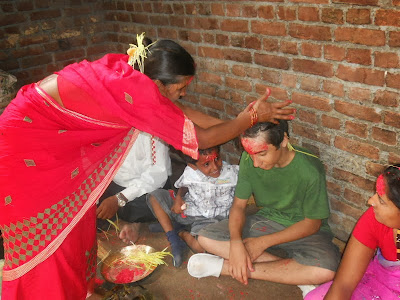
The central activity of Dashain, its ceremonial raison d'etre, is to get blessed by your elders by having them plaster your forehead with yogurt, uncooked rice, and red powder. Why that's a blessing I do not know. It seems like a ritual invented by the Three Stooges when they couldn't find a cream pie. Is it marking the harvest? Is it reminding us that we're all ultimately part of the food chain? 


No one I've asked could ever explain it. Oh, they could theorize, but the genesis of the smeary wet blessing is as vague and speculative as the origins of Christmas trees and Easter eggs, and no one thinks about the origins anyway when they're doing it. It's just what people have always done. It's fun. It's Dashain. And it's got that whole Hindu too-much-of-everything-is-just-enough vibe: You want a blessing from me? Well, here's a LOT of blessing! It's dripping off your forehead and onto your new Dashain clothes! 


From top left: Young family members waiting for the feast and peeking in at the kalash, a ceremonial vessel to welcome goodness and fortune to the house, generally filled with water and leaves such as mango and pipal; Getting tika (blessings) from my husband's sister; Son getting a blessing from a great-aunt; Happily dripping niece. 


BUT, you ask ... 

WHAT DOES THIS HAVE TO DO WITH ZOMBIES? 


(Other than the blood and gore part. And the part about Evil let loose in the land. And the fact that trying to do design in Blogger is turning me into one.)

Here's the thing. My son, who of course is always reliable, reports that in the last few days he has seen several men -- not one, not two, but at least three -- wandering the neighborhood, growling and grimacing and acting like they wanted to bite. I told him he was either totally exaggerating or they were drunk or crazy. Mental health care isn't exactly state-of-the-art here.

He said, "Watch out. The skeptics are always the first to get bit."

But see, luckily, we're headed within walking distance of our Designated Anti-Zombie Hideout. It's not our family's current village, which is too flat to keep away zombies. But as you surely know from World War Z, zombies cannot climb and are particularly stymied by the Himalayas. So our destination, in event of zombie breakout, is my mother-in-law's family village, which isn't far, relatively speaking. It looks like this: 


18th c. painting of Durga fighting
the demon Mahisasura. 

You see that she is well-positioned 
to hit zombies in the brain,
where it counts.

We just have to get there, block off the lone dirt road (conveniently edged by sheer cliffs), and bide our time eating home-grown rice and lentils and guavas until the Zombie Apocalypse ends. Hopefully Durga will help out. They've got a lot of goats to thank her with.


So if you don't hear from me for a while, I may be celebrating Dashain in the village, or the zombies may be coming and we saw them first and have headed to the heights and I'll be able to say "I warned you." 

Either that or my son is right and I'll be saying AAArrrrgggROWL CHOMP.


Nepal's main "highway" and the best road out of Kathmandu -- 
almost the only one --
crowded with travelers at Dashain on its two cliff-hugging lanes.
An excellent terrain for evading zombies. Unless they're in the cars and buses,
in which case it will be a zombie jam. And we'll all be jam for the zombies.


Tuesday, October 8, 2013

Shake the Tree and Pour the Rum, It's Guava Season


In Nepal, we live seasonally. Mango season is over,  but now it’s guava time. We're lucky enough to have two trees at our house -- well, not "our" house exactly, the landlord's house, but it'll do -- which means I can pick guavas from the balcony without going to the trouble of putting on shoes. Alternately someone can climb the tree, which is not my option of choice, or hit the branches with the mutilated leg of a camera tripod.

As most people don't look at a tripod and think "Guava Retrieval Stick," this requires an explanation. One day my son was filming at the sprawling and forested complex of Pashupatinath Temple when two monkeys, showing a capacity for teamwork and collaboration and goal-directed thinking that would make an aid agency trainer proud, grabbed his tripod and ran off with it. My son, being a teenager and hence having forgotten to pack his brain that morning, ran after the monkeys, down the steep slope and into the tangled underbrush that was probably full of snakes, none of which fortunately bit him as he ranted and raved at the monkeys and the monkeys bared their teeth and fortunately didn't bite him and inspected the stolen tripod and did their own version of ranting and raving when it turned out not to contain any food, and then threw it back at our son in disgust. 


That's how we have only a tripod leg. But it’s good for knocking down guavas. Next time any monkeys come around, we're armed.

Monkey thinking deep monkey thoughts. Watch out for your bag. Or tripod. 


As a presumed 99 percent of the audience of this blog already knows (because you know me personally which is why you're reading it, thank you, I'll read your blogs too now!), my husband is Nepali, and although we lived in the U.S. for years, he grew up in a small village without anything fancy like electricity or running water or a toilet. Not even an outhouse. People just took a morning trip to the riverbanks to do their duty, with the Brahman and Chhetri men looping their janai, or sacred thread, over their ears as they did their business and then not un-looping it, so that you knew who had just taken a dump. Village life isn't big on privacy. 


This relates to guavas because the encircling jungle, where you went anyway to cut firewood, was also a popular place for nature's business. The result was an abundance of whatever seedy things people had eaten, particularly guavas, chili peppers and tomatoes. They all grow wild in the jungle. 


Son and friend at the fringe of our family village, where the jungle, although heavily cut, can still be seen:

Children pick the fruits wild and also become adept at stealing the fruits from neighbors’ trees. I see it here, too, on my lane in Kathmandu. The other day I passed a group of boys who paused guiltily in the act of climbing a wall and knocking down guavas from a tree not their own. It's the kind of Tom Sawyer, Norman Rockwell-ish activity that would get a kid tagged as a delinquent in the U.S. 

Guavas are pulpy and semi-tasteless before they're truly ripe, but when they're ready, they’re heavenly. And they're surprisingly potent, health-wise, much like blueberries. A study on fruits common in India, which I have been scholarly enough to link to, at least in its game-of-telephone newspaper form, concluded that the guava, "exotic in Europe but a poor man's fruit in India," is "the ultimate superfood," with the highest concentration of antioxidants in the study.

The guava is a so-called "poor man's fruit" in part, perhaps, because they're known (at least among rural people) to grow from poop, which doesn't tend to give them an elegant reputation. And they're ubiquitous. Kind of like crabgrass or McDonald's in America. I'm in the city, but we're knocking guavas off the tree daily. The landlady was just sweeping the yard and complaining about all the guavas littering the ground. The dogs use them as balls. One almost conked me on the head today. 


In fact, unripe guavas make excellent weapons in the hands of monkeys. If you throw something at a monkey, it may well throw it back, since monkey do know how to use their opposable thumbs to achieve their goals, such as whacking village kids on the head. A monkey can supposedly kill a person with a guava. 

Here's what you apparently get from a guava, aside from a possible conk on the head:
  • 209 percent of the recommended daily amount of Vitamin C.Take that, orange juice. Not just 200 percent, but a 9 percent bonus.
  • Vitamin A in the form of beta carotene. Funny, it doesn't look like a carrot.
  • Some research suggests they can help fend off diabetes. A healthy sugar? Cool.
  • It can be used against diarrhea and other intestinal problems, which is good to know when you live in Nepal.
  • More potassium than an equal serving of bananas. Although a monkey is less likely to use a banana as a weapon. 

Having a superfood at arm's reach to provide us with anti-oxidants is helpful in Kathmandu, for reasons you can see.

And yet it's not all smoke, dust and asthma here. Politicians come to the rescue. Yes, because of politicians and wannabe politicians, there are strikes (bandhs) that shut down the city with some regularity as political parties protest other parties and try to make people do what they want and only what they want. It's rather like snow days in Washington DC. Actually it's like other things in Washington too. But it does have benefits. This is the city without traffic, on a lovely clear bandh day.                                                            


Now, since this is a blog and you've already scrolled down all this way, and endured terrible newbie blogger layout to boot, it's my ethical duty to offer some recipes. Besides, every woman who blogs and mentions her kid and isn't crafty must at least give recipes once in a while. I believe in Rule of Law.


So here comes the recipe section


These are some Laziness Approved Recipes for using fresh guavas. If you're reading this in the northern realm of the blogosphere, like Cleveland or Helsinki, then you can use packaged guava juice and think of us in exotic Kathmandu, plucking guavas in the shimmering shadow of the Himalayas. Nyanyanya. Cough cough. Whoops, that shadow was actually diesel smoke.


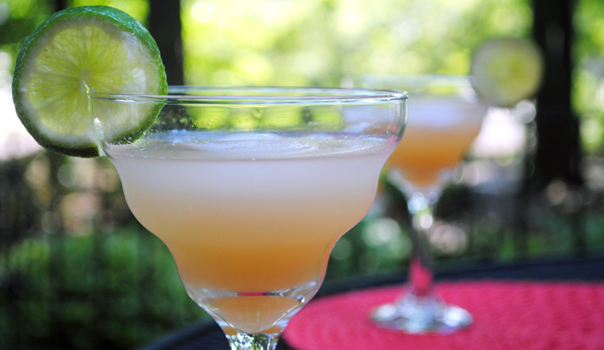
Guavaritas


8 ounces Guava nectar
4 ounces tequila
4 limes

Juice three of the limes, to get about 3 tablespoons juice, and slice the last lime in round slices for garnish.
Mix and shake with ice cubes (Recipe says "in cocktail shaker," but we don't exactly have one here. Luckily the human mind can figure things out.)
Strain, garnish, enjoy


Guava Lime Coolers


7 cups guava juice (not pre-sweetened)
  • 3 cups white (light) rum
  • 2/3 cup fresh lime juice
  • 1/4 cup grenadine (pomegranate-flavored syrup)
  • Ice cubes
  • Lime slices or wedges, or fresh guava slices
  • In a large pitcher, mix guava juice, rum, lime juice, and grenadine. Pour over ice in glasses and garnish with slices of lime or guava.
West Indies Guava Barbecue Sauce


1 guava - peeled, seeded, and chopped (seeded? What, OUR guavas? What'll be left?)
1 (15 ounce) can tomato sauce
1 (6 ounce) can tomato paste
1/2 cup water
1/4 cup brown sugar
2 tablespoons liquid smoke flavoring (Ha! Just where would I get that here? Yet we will survive.)
2 tablespoons fresh lemon juice
      1 tablespoon Worcestershire sauce
1 tablespoon habanero hot sauce (Something tells me it doesn't absolutely HAVE to be habanero.)
1 teaspoon molasses 
1 tablespoon garlic powder
1 tablespoon onion powder (Whatever. I could pulverize some onion instead.)
1 teaspoon salt
1/2 teaspoon black pepper 


In a large saucepan over low heat, stir together the guava, tomato sauce, tomato paste, water, and brown sugar until well blended. Stir in liquid smoke (sic), fresh lemon juice, Worcestershire sauce, habanero sauce, and molasses. Season with garlic powder, onion powder, salt, and black pepper. Cover and cook 30 minutes, stirring occasionally, until thickened.


Enjoy! If you have guavas that is.