Tuesday, April 8, 2014

A Happy New Year Vampire Story to Welcome 2071

I've been so behind in posting these days that I should call this Too Lazy To Blog. Which really would be a new high (or low) in laziness. But fortunately, a new year is coming, and so I can turn over a new leaf while I thank a vampire.

This is a non-sparkly Hindi TV vampire.
And yes, this is related to New Year's. Which is this weekend,
in the same part of the world in which this cheery fellow is considered
to be a fun character for a children's show. Who needs Big Bird?

OK, I know what you're thinking. "I'll let the vampire part slide for a minute, because you've clearly lost it, but what do you mean, new year? You may be a bit slow on the uptake, girl, but it's been 2014 for a while now." That's where you're wrong. Here in Nepal, we're almost done with the year 2070. This weekend, it will turn 2071. Here's proof in the form of a real Nepali New Year's card with a Nepali New Year's Unicorn (or maybe a New Year's My Little Pony) for those who don't find my New Year's Vampire sweet enough:


Our calendar is called the B.S. calendar. It doesn't stand for what you might think. And it isn't one of those calendars that just get trotted out on special occasions, so that people can go to a Chinese restaurant and say Happy Year of the Rat without really leaving 2014. No, it's pretty much NEVER 2014 here. Or January or April. Today, for instance, is Chait 27, 2070, not April 8, and if you're going to a government office or planning a meeting you'd better remember it because no one else will be paying the least whit of attention to April 8 and you will be 56.7 years late.

Of course, our confusing calendar does mean that this guy ...

My father-in-law, dressed in his Junior Soprano outfit in Mustang, near Tibet.
He knows the appropriate words to ward off vampires,
and since I'll post more pictures of them it's good to have him around for safety.

... was born the same year as this guy:

Teenager who doesn't like sparkly vampires
checking to see if cannon is loaded 


So what is the special occasion that is marked by Year One in the B.S. calendar? Well, uh, people aren't sure. The B.S. stands for Bikram Sambat, or Bikram's Era, and was supposedly established by a ruler named Bikram a.k.a. Vikramaditya -- alert readers may notice the V, but that's close enough to B for us here in the land of random spelling -- who may have created the calendar to mark his victory over the Sakas. They turn out to have been nomads from Kazakhstan. I have no idea how an Indian king ended up in Kazakhstan, but maybe that's why he needed a new calendar, along with a new map.

Anyway, some people see this as the same King Bikram who carried a vampire around. There's an old legend, dramatized in a classic children's series on Hindi TV, in which, listen up children and gather around the TV for your bedtime story, Bikram goes to a cremation ground where he meets an evil old sadhu who will give him a wonderful gift if he brings him a corpse. So Bikram finds the corpse and it turns out to be a vampire, ha ha it's not dead after all, and each day the vampire tells him a story that involves a riddle that Bikram has to answer correctly or die.

Bikram with the vampire.
I think I'd want a new start, too.
I'm picturing the production meeting. A story a day, for 25 days! Children love stories!

The first story involves a bride who tries to commit suicide after her husband dies. There is also a bandit attack and a beheading -- great, that means pretty bridal costumes for the girls, action for the boys! -- and then a mistake in which the husband's head is put on the wrong body and reanimated, and in the end there's an interesting educational riddle for Bikram and the kids to solve about whether the bride's real husband is the body with the wrong head or the right head with the wrong body.

I wonder if there are any action figures. They could have interchangeable heads.

Although at least our South Asian vampires could beat the crap out of any sparkly Twilight vampires. And the kids who grew up with Vikram Aur Betaal can be counted on to be able to cope with absolutely anything that life may toss them. Which may be the point. No electricity? No water? Third world politicians? No problem, I grew up with vampires at bedtime.

At any rate, everything in Nepal runs on the Bikram calendar: the governments, the schools, the fiscal year, the bus schedules, and apparently this blog as well since it's been so long between posts. I'm going to blame it on the whole B.S. thing.

So now, on the occasion of 2071, I think we should all have some drinks and thank a vampire. Because in the end, he teams up with Bikram to kill the evil sadhu (who my husband informs me isn't really a sadhu because they're never evil but a tantric, in case you've stumbled onto this blog while doing research for a term paper), and I guess the two live happily ever after, coming up with a new calendar or something. If you'd like, you can even download the Android app:


Happy New Year 2071, kids!


Saturday, February 15, 2014

Small is Beautiful: The Two-Hour Sari Blouse

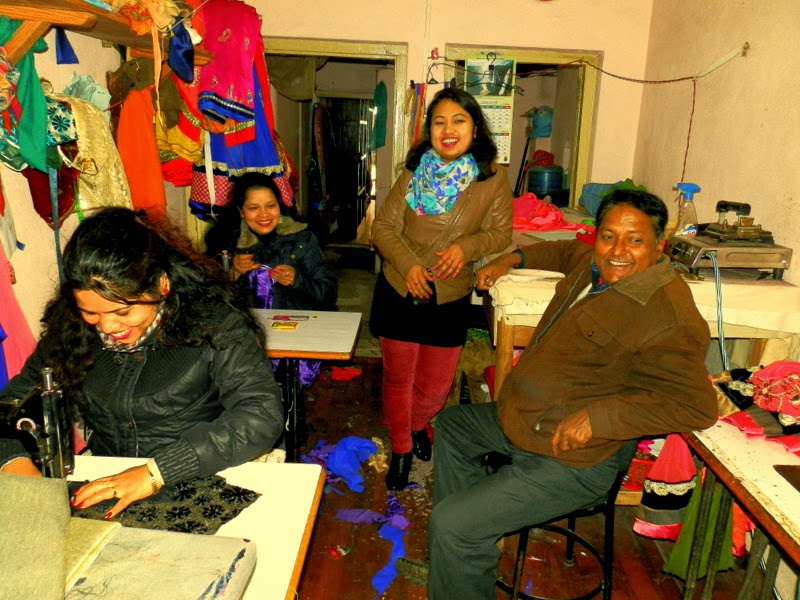
Everything was done in my neighborhood,
at one of Kathmandu's thousands of woman-owned  small local businesses.
By "everything" I even mean the hand-stitched goldwork embroidery.
(No, it's not mine. I wish.)


Here are two of the reasons I love living where I live.

            a) I get to say things like "I need a sari blouse" and really mean it.

            b) If this notion just crosses my mind a few hours before the blouse is needed, I can get one made from scratch -- all within two hours, and in my own neighborhood.

Okay, I know I should be saying that I love where I live because of the rich multicultural tapestry, the opportunity to make a difference for the poor and oppressed, and the exciting entrepreneurial spirit that poses a feisty challenge to the globalized status quo. All of which is true. But it's also weirdly cool to wake up and realize, "Ohmigod it's cold, and I'm going to a wedding reception tonight, and so of course I'll wear a sari, but I don't have a long-sleeved sari blouse! Oh no, whatever shall I do?!?"

The Western equivalent of "I need a sari blouse" might be "I need a little black dress." But, see, little black dresses are boring. They're the definition of "meh." Coco Chanel killed fashion in the West. Well, Coco Chanel plus the fact that truly cool things like beads and embroidery cost a lot of money, plus we're really a bunch of Puritans inside and so it was such a relief to the Western mind when it turned out that color and ornamentation weren't okay anymore.

Watch out. This may turn into a fashion blog.
What I suddenly realized I'd end up wearing
inside at night, with no heat. Brrrrr.

Anyway, sari blouses. They're usually short-sleeved, which is dandy in balmy India, but Nepal is higher and colder. You can cope with this at a fancy winter party by either wearing a sweater with your sari (practical but frumpy, and I'm frumpy enough without help) or a shawl (in which case what's the point of the nice pleating you just spent half an hour trying to get right?). Or you can have a long-sleeved sari blouse. Which was the only option that would also allow me to don thermal underwear and smile at the bride without chattering teeth. So it was a no-brainer, except that, speaking of no brains, I only realized this a few hours before the party and had no long-sleeved blouse.

Oh, I could get away with a salwar kameez. Heck, I'm a Westerner, so I could get away with jeans and a down jacket; yeah, I'm married to a Nepali and get brownie points for getting the culture "right," but they'd cut me slack. Still, what fun is that?

So off I went off to see which of the tailors and seamstresses in the 'hood could make a purple velvet blouse in a few hours. Notice that I said which of them, because there are many tailors and seamstresses within a 10-minute walk. That is because Kathmandu is fantastic. Oh, it's chaotic and congested, but it's got real neighborhoods, and they're built (or rather, grow organically) to make it easy to shop on foot for pretty much everything. Of course, this is because most people don't have cars, which has its obvious negative side, but it's great for walkability and small business. This is still a town for people, and not for the chain stores, strip malls, and highways that kill small business and turn communities into sterile wastelands that only corporations and Hal the 2001 Computer could love.

If you see a mannequin, you know it'll cost.
OK, end of rant. Within a few minutes, by foot, I had checked five hole-in-the-wall shops and found two people who could make a blouse within four hours. But that was still too slow, since a Nepali "four hours" means "five or six hours if the tailor shows up."

Finally, I found a boutique -- which means "has glass windows, mannequins and charges more" -- that had purple velvet in stock and could make a blouse within two hours, starting now. It's one of thousands of woman-owned tailoring and clothing shops that provide people with a living (many of them other women who can work on fairly flexible schedules) while also, as it happens, keeping much of the money in Nepal and preserving a South Asian fashion culture that is a rich alternative to mass-produced global dullness. I'm a big believer in "small is beautiful," and in the case of small shops and boutiques, it's quite literally beautiful.

The six people who make a living here include this guy, the goldwork embroidery master. It was incredible to watch him work. His name is Lal Mohammed, and he is originally from Janakpur but learned his trade 20 years ago in Calcutta. The gold-colored metal thread seems to spill from his hands like magic.

The velvet for the blouse is stretched on a frame
He told me that a lot of embroiderers go to Saudi Arabia and other Gulf states for work, because people there can afford elaborate goldwork clothes. But he doesn't feel it's safe for workers, and isn't convinced that the pay would be worth it. His salary isn't high -- it's on par with a lower-rank police officer or teacher, all of whom struggle to make ends meet -- but in fact that's close to what many remittance workers end up earning per month, and they also end up in debt to manpower agencies and away from their families for years while living in virtual slavery. So instead, he's doing his work in the back of a shop in my neighborhood.

It takes a week to make a blouse like this.
Goldwork involves a needle-like tool that seem to catch the fabric,
but I'll be darned if I could figure it out by watching.

These will become the neck trim.
The term "goldwork" doesn't necessarily involve real gold,
but metal threads that look like gold or silver.


Lal Mohammed's bead work, or a little black dress?
Oh puhleez. It's not even a contest.


Rojina Shakya and Sita Shrestha are two of many women entrepreneurs
who run their own local clothing shop, in this case featuring their own designs
Theirs is called Aava and you can find it at Dumkul,
around the corner from the Jawalakhel Salesway.

Along with the owners, who also do some of the stitching,
and Lal Mohammed, the shop employs a master tailor and two seamstresses --

who, of course, work on pedal-run sewing machines. 
If you had an electric sewing machine in power-starved Kathmandu, 
you'd be working in two-hour stretches at midnight. That or broke.


Well, I had neither the time nor the budget for one of Lal Mohammed's masterpieces, but in two hours, I had a warm, well-lined blouse in purple velvet with silver trim. With my sari and high-performance thermal underwear a la snow camping, I was all set for a wedding party in the Himalayan winter. 

I'll put up a better pic if I find one,
but for now, here's a mirror selfie with purple two-hour sari blouse.
I've  also got two layers of thermal underwear on.
Otherwise I'd look svelte, of course.

Friday, January 17, 2014

Hollywood Comes to Kathmandu and I Get a Scene. (With Josh Brolin. Not the Chickens.)

You know those fuzzy pictures that claim to show the Loch Ness monster? This one is clearer. So you can have no doubt that it's really me, with Josh Brolin, on the set of Everest, the movie version of Jon Krakauer's best-selling book on the 1996 Everest disaster, "Into Thin Air." It's filming here in Nepal until they move to the Alps and Iceland so they can breathe while filming. The real Everest can be a little unfriendly, oxygen-wise. (So can Kathmandu, actually. But it makes up for it in colorfulness. Which the movie crew signifies with chickens. I'll get to that later.)

Me and my fuzzy co-star Josh.
Also, I think that's Bigfoot walking behind me,
and the shining white light comes from a UFO.
Think this'll go viral now?

I got to play a key role with Josh Brolin -- at least I consider it a key role, though a subtle one (hey, there are no small roles, just small actors) -- in a crucial scene that establishes his character as a decisive mountain-climbing dude who is also bluff and pushy and sure to clash with others on the slope. (You can tell a lot by the way a man picks up a backpack.) Josh Brolin is playing Beck Weathers, and if you live in Nepal and haven't read "Into Thin Air" and thus don't know who Beck Weathers is, you're in danger of having your visa revoked.

I play Western Woman in Kathmandu Airport Who Almost Bangs into Beck Weathers Repeatedly.

It wasn't really in the script. My official part was Extra Who Walks With Other Extras Behind Beck Weathers aka Josh Brolin As He Picks Up His Backpack Ruggedly. But spontaneity and improvisation are such an important part of the creative process. Plus it was a really narrow area. And given the choice of banging into Josh Brolin or another extra, I picked Josh Brolin.

"The cameraman will come walking backward, with a very expensive camera,"
said the Second Second Assistant Director to us extras.
"Do not bang into him and his very expensive camera."
Nothing was mentioned about not banging into the very expensive movie star.

In case your memory is fuzzy in regards to "Into Thin Air," Beck Weathers was the cocky Texas doctor (and avid Republican: note his Dole t-shirt and expect lots of good Hollywood-style arrogance and conflict) who was climbing Everest when a blizzard struck and he was blinded, lost, stranded, frozen into a human icicle and left for dead twice until he staggered through the blizzard and became the subject of the highest helicopter evacuation in history. He is, quite possibly, the toughest man on earth.

As for Brolin, he was in No Country for Old Men, True Grit, Men in Black 3, and a bunch of snapshots and iPhone shots on the set of Everest.

Anyway, a crew from Pinewood Studios in London came here to start production on the film, which also stars Jake Gyllenhaal as groovy wild-man climbing guide Scott Fischer and Jason Clark as level-headed guide Rob Hall -- both of whom die on Everest along with six others (which hopefully doesn't need a spoiler alert because you already knew that) -- and they needed some Westerners to be extras in it.

I'm not under 18 and don't have two heads and hence I made the cut. Plus, being a historic costume geek of the first order, I helpfully arrived with my own costume, a skirt that I really did wear in Nepal in 1996, a point which I made to the Costume Director, who of course approved. Or anyway he looked me up and down for three seconds and then said "old hippie" with a very British sniff, but I guess that was a note of approval, because it saved me from wearing a skinny pink shirt from the wardrobe rack via eBay like the extra next to me.


I finally get to do costumes for a movie!
Here's my historically accurate worn-in-Nepal-in-the-'90s skirt,
with appropriate trekking top. I'd have worn my Grateful Dead socks,
too, but they are in fact post-'90s and that would have been a terrible lapse.
This is the bus and props used for the movie. You saw it here first.
Watch out. The costume director got pink stuff
on eBay, and he can make you wear it.


So now, for the benefit of those who have always wondered about life in the glamorous lane, I'll explain ...

The Extra Selection Process: Nepal Version


1) Either get an email on the expat listserv or get tapped on the back by the Second Second Assistant Director who cruised the tourist area looking for photogenic types; as you can imagine, I got the notice by email.

2) Go to the five-star hotel where the film folks are staying, the posh Hyatt Bouddha (which isn't as posh as Dwarika's but has better parking, which you need if you're making a movie that involves buses with chickens). Then stand around in a line with other extras like you're up for auction while the makeup crew scrutinizes your face and hair, followed by the costume "triage woman," who pulls out of the line the obviously non-'96 folks so they can get stuffed into pink t-shirts and other eBay finds. She also apologizes repeatedly for how cold you are, which you are not if you live here, because you knew it would be inside and hence dressed in many layers of thermals in Kathmandu Pillsbury Dough Boy Fashion, whereas all the Hollywood folks were operating under the illusion that "inside at a five-star hotel" meant "warm" and suffered the consequences.

3) Keep standing in line (perhaps as a test of your capacity to endure film-set boredom) until the arrival of the costume director, who looks at everyone like Mr. Blackwell picking the Hollywood Worst Dressed List and has many ways of pronouncing "no" -- nooOOoo, nnnnnO, NO -- all of which communicate utter disdain. But I passed muster because I guess he could use an "old hippie." And besides, I'm sure he could tell that, in my heart of hearts, I would love to be a movie costume director (although I clearly need to work on my pronunciation of the world "no" and also on my tolerance for pink.)

Filming commenced the next day on a bus and then at Kathmandu's domestic airport, which was standing in for the international airport circa 1996. Mr. Brolin's job, in the scene in which I appear if I'm not cut, involves ...

walking up to a cart full of trekking gear and swinging his backpack over his back. 

Which he did very decisively, I must add. Over and over. From many angles. He made the bag look heavy. Which it wasn't, because they were all empty. He then walked forward with his pretend-heavy backpack as I walked behind him, along with other extras who had been instructed to look "confused" (since we were looking for our bags), and it was a narrow area and I did "confusion" so well that I kept brushing into Brolin, which wasn't planned, but I would argue that banging into another foreigner is an important element of character development and symbolizes The Likelihood of Future Conflict, along with the Dole t-shirt, and hence should not be cut under any circumstances.

There were several scenes filmed at the airport, mainly involving bags and walking. In my spare time, of which I had a great deal, I took bad pictures of ...

Location, Location


The setting of my important scene,
with baggage props and cardboard box props

and people wondering onto the set, which actually was a working airport. 
So they'd film a bit, and then Nepalis would wander in and talk on their cell phones 
and line up for flights, and then they'd film again when it cleared up.


Details. (Someone Was Paid to Do This.)


Is this cool or what? There's SO MUCH DETAIL
that they actually have little tags on the luggage with the character names. 

This character is an older, experienced climber 
who sensibly decided he can't make it and steps aside, and hence survives.

Chickens, to Signify Nepal's Third Worldiness


According to Hollywood, Nepal's airport has buses with chickens on them.
Silly Hollywood. Our chicken buses aren't at the airport. (Usually.)
But think about this: someone who worked for the movie
had the job of finding both a very beat-up bus and some chickens for it.


And the Oscar for Costume Design Goes to ... This Guy?


Persnickety Costume Director (far left) inspecting extra-wear at the Extras' Wardrobe-and-Dal Bhaat tent.
Yes, they fed us dal bhaat. I think we were supposed to get a box of sandwiches
from the Hyatt Bouddha,, but the drivers ate our sandwiches and so we got the Nepali food,

which was dal bhaat and probably better than the sandwiches anyway.
They get points for several things: 
1) The Second Second Assistant Director (at center in the puffy black vest) helped serve us lunch; and,
2) Lunch included both alu achar AND lapsi achar. Good job, all around.

Extras Hard at Work


Western extras, waiting at a ticket counter
for the scene where they play people waiting.at a ticket counter.
More extras, looking 1996-ish.
I'm a historic costume geek, so naturally
I took lots of pictures of the costumes.
(Stars? What stars? I want to see how they do '96!)

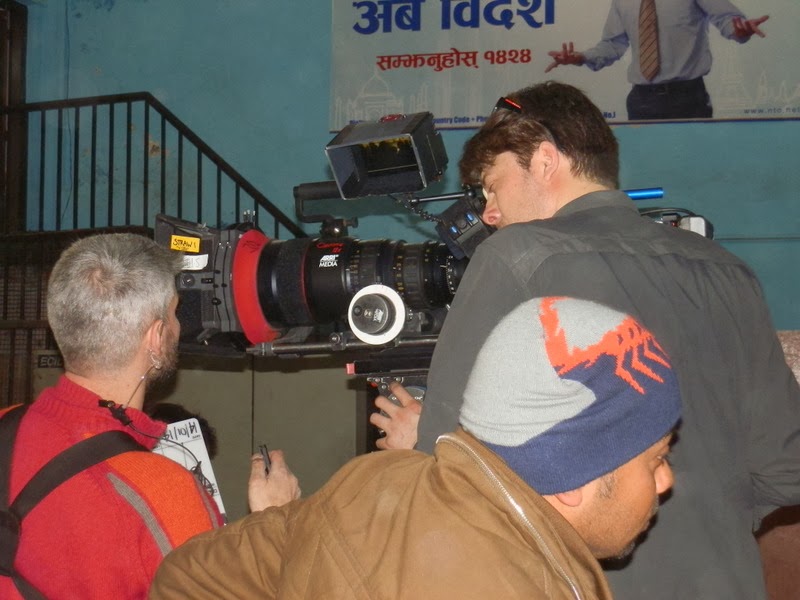
Cameras Are Really Big and Heavy


Filming something.
Granted, my shot isn't exactly a good one,
but that's why he has a job as a cameraman in movies and I don't.

The Ones That Got Away


Not extras, but if I worked for the movie, I'd have made them be in it. 
These folks were definitely around in 1996.  I suppose they were headed to a plane,
but wouldn't they rather be in a Hollywood movie?


So there you have it. My day with the stars.

Check it out when it hits the big screen: Everest. Or maybe it'll be called something else by then, like Into Thin Air or Spiderman on Everest. It stars Jake Gyllenhaal, Josh Brolin, Jason Scott and me. Plus a crate full of chickens.


Thursday, January 2, 2014

Indiana Jones and the Ratty Nepalese: A Winter's Tale

Meet The Ratty Nepalese, a character in Raiders of the Lost Ark, wherein his job is to attack Harrison Ford at a bar in Nepal. Which is located, it turns out, in Patan. Just like me.

The Ratty Nepalese.
That's really the official name of the character
played by, uh, Malcolm Weaver.

There are three things that people not in Nepal tend to think of on those rare occasions when Nepal happens to cross their minds: Mount Everest, yetis, and that bit in Raiders of the Lost Ark where you see Marion's bar in the howling, snowy remoteness of the high Himalayas. I bet you didn't know that Marion's bar was in Patan. But apparently that's the case.  So according to Spielberg, this is what my house should look like.

"It's a crummy dive in a Nepalese village that  nobody would otherwise visit,
but the local enjoys the warmth of the fire, and the climbers who hike through here
enjoy the company and the booze." -- Marion Ravenswood, on her bar in Patan

Those who know Nepal might quibble that Patan is a city of over 200,000 people who answer census questions (and maybe a million who don't), and is to Kathmandu what Brooklyn is to New York. It's K-Town's Siamese twin, or rather Siamese quadruplet, since there were once four kingdoms in the Valley -- Kathmandu, Patan, Bhaktapur and Kirtipur -- whose kings, being relatives and hence bitter rivals, engaged in a long game of one-upmanship that involved trying to build more temples than each other. It was a familial Cold War fought with temples, and left the Kathmandu Valley with more temples than Wyoming has missile silos. They're everywhere. And so, now, is Kathmandu, which is really one tangled multi-limbed quadruplet of a city, complete with clogged arteries and, well, a whole lot of temples.

In spite of all the concrete and an overall population of maybe 2 to 5 million (give or take a million, because who's counting?), it doesn't sound right to use the word "metropolis" for a place where cows roam on dirt streets. But Patan can be told apart from Kathmandu only because they're divided by the Bagmati River, which you could walk across if you were a cow and didn't mind using shoals of plastic and coagulated debris as a sidewalk. I have seen cows walk across it, munching on plastic. Free-range cows, fed on free-range plastic. Got milk? It comes with added BPA!

I'm in Technically Patan, but it would take me about 10 minutes by bicycle to get to Technically Kathmandu, if I got up the nerve to brave the highly creative traffic pattern and didn't get smacked by a hit-and-run motorcycle or fall on the bumpy potholed roads. Both of which have happened to me. Whereas it does not look as if Marion had that particular worry, in her version of Patan. Although she did have to worry about Giant Sherpas, who have not, thus far, caused me any particular trouble.

At left is Indiana fighting in the frigid remoteness of Patan with The Giant Sherpa, played by Pat Roach (who was also The German Mechanic in the same film, the Chief Guard in Indiana Jones and the Temple of Doom, and a Gestapo in Indiana Jones and the Last Crusade, and thus may have been Indiana's most persistent foe.) At right is a Not Giant Sherpa, Tenzing Norgay Sherpa, with Edmund Hillary during their first interview after they summitted Everest in 1953. Hmmm. Come to think of it, he really was kind of giant.                                                                 

Actually, Patan looks like this, if you're taking pictures for a guide book ...

Patan Durbar Square, about a 20-minute walk from our house

             ... or like this, if you're just taking pictures of your kid on the roof ...

Scenic view from our roof, with teenager, laundry and urban sprawl

                                    ... or sometimes like this, if you're walking down the street and all of a sudden a giant tree thing comes lurching at you.

Happy Holidays! But this is not a Christmas tree. It's built to make it rain,
which it achieves each year by getting pulled on ropes through the streets of Patan
by the people of Patan, or at least by a bunch of rowdy young men,  as a huge crowd follows because

it's sacred and it's tradition and also because it's like watching a giant wreck about to happen.
And it does rain afterwards. So I'm not arguing with experience. 
Plus I wouldn't want to jinx it. The darned thing is about five stories tall.

See? No snow. No howling wilderness with Ratty Nepalese and Giant Sherpas bursting in from the cold to have fights with Indiana Jones. No Sherpas at all, traditionally, since their homeland is up north in Solu Khumbu (at least before half of them bought trekking agencies and then moved to the US to run restaurants). But here's the thing. You don't need snow to be cold. What you need to be cold is to live in Nepal in the winter. Because we have no central heating. So on another level, beyond the deceptive surface of concrete houses and stores that sell Tang and transplanted Sherpas who run trekking agencies and own multi-story houses with marble floors and yet no heat (until they get tired of being cold and move to Florida and rent their house to foreigners), this is definitely Spielberg's Nepal.

Except for one problem. Look at that fireplace. Seriously. That FIREPLACE. Who has ever seen a real Nepali house with a fireplace like that?

I want that fireplace!

You get this ...

Typical rural cook stove

Or you get this ...


True, it doesn't have quite the golden romantic glow of a fire in a traditional home.
But if you need a fire,  well, you can build it right in the hallway.
And if a Giant Sherpa comes in, she can disarm him easily by offering a cup of tea.

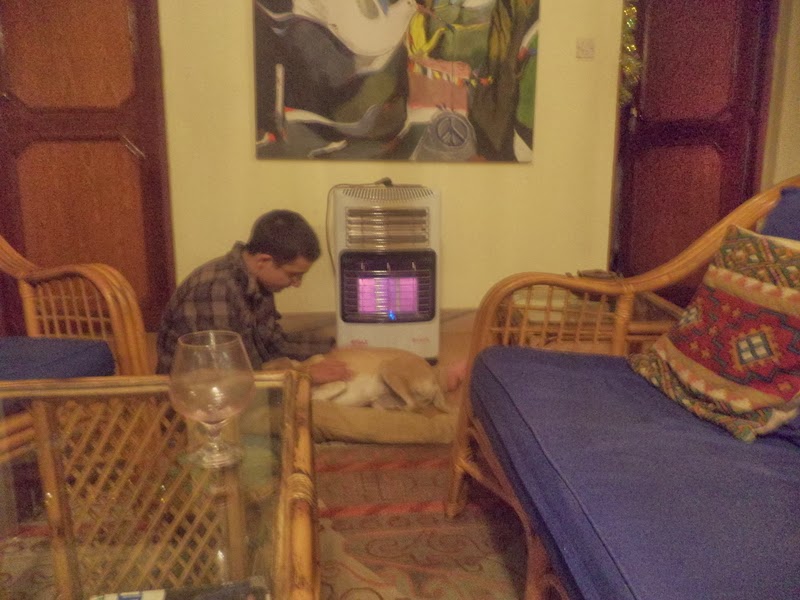
Or, in the city, you can enjoy the warm glow of liquid propane cylinders in cabinet heaters.


But you don't get fireplaces in a Western sense, with a mantle to decorate for the holidays. Not unless you're in a tourist guesthouse or a modern house with a fireplace added so it can be rented to expats. Fireplaces in Nepali homes are practical affairs: they're either mud stoves or, high in the mountains, open hearths in the middle of the floor, and you cook on them as well as warm yourself. This is why, when we lived in Washington DC, my husband may have been the only guy in our neighborhood to roast potatoes in our living room fireplace. And it's also why my mother-in-law, when she visited America, had absolutely no interest in sitting around the fire just to look at it. She'd been making fires every day of her life; to her, it was about as fascinating as sitting around gazing at an oven.

Many years ago, on my first trip to Nepal, I recall the complaints of a French couple I met on the trail in an area with few tourists and no "apple pie" guesthouse culture: It is smokey. We cannot sleep in the houses because it is smokey. Why do they not have chimneys? In France, all the old houses have a chimney. They had come to Nepal and discovered, to their chagrin, that it was not France.

All would have been well if they'd just found Marion's bar. Because she has a lovely fireplace, with a mantel and everything. I am going to look for Marion's bar right now, because there's a gas shortage and our cylinder needs changing and we will soon be freezing in the cold chill of Spielberg's Nepal.


Marion's fireplace has the added benefit of coming with Harrison Ford.
My source of heat is a cabinet heater with gas cylinder. It comes with my husband.
But he does have an Indiana Jones hat. So it all works out.


Sunday, December 15, 2013

The Diesel-Fueled Time Machine on Winter Setting

My  medieval self(ie)
Ok, it's not really a selfie.
I started to memorialize my everyday
Medieval Ellis Island Baba Yaga
Goes to Market look,
but The Teenager stopped me,
because apparently moms
are already lame enough
without being selfie-takers .
For historians, a stint in a place like Nepal should be mandatory. Like basic training in the Army. Literature scholars could use it too. And filmmakers. I can arrange it, for a small fee.

We live here with a foot dipped into Medieval Normal. Not Medieval Exotic (which is the tourist experience), but Medieval Normal. That struck me in a visceral way last evening, as I flipped a shawl over my head against the night's chill and headed down the lane with the other triangular shapes of shawl-encased women, all strolling to the street market where vendors sat at their carts in the dark and children hovered nearby at a fire. I bought, naturally, some turnips. (What else would I buy, dressed in a shawl?)

In our Medieval Normal, water for washing has to be hauled at times from the well, and clothes don't dry if there is no sun.

This morning I woke to the sound of a gayin, a minstrel going house-to-house and singing outside the gate for spare change or his daily bread. (Well, a bowl of rice poured into his sack.) It was normal so I went back to sleep.

Hawkers come down the street chanting their wares, knives to grind, knives to grind. 

The Teenager wears a wool cap inside; my husband has a nightcap. We take sartorial tips from Clement Moore. Mama in her kerchief, and I in my cap, had just settled down for a long winter's nap  ... 

You don't bundle up to go outside; you bundle up because it's winter. You don't step out of the cold into toasty homes, because they're not. We have no central heating. No matter how privileged you are, you will huddle all winter in shawls and blankets, by sources of heat that come with flames. There'd be a democratic justice in that if the poor didn't end up relying less on heat (since fuel costs money) and more on getting really, really tough. Which they do. Do not mess with a poor person from the "developing world." They will out-tough anyone who hasn't come through a time machine. Although if anyone from the past ever does step through a time machine, take my word for it: Definitely do not mess with them.

OK, Jon Snow, you are hot, but not THAT hot.
Put on a hat. Like your mama says. (Oh. Sorry.)
In our Medieval Normal, we keep candles because we need them, and sometimes have to read by their light. OK, we also watch videos by them, because the not-very-medieval inverter that stores backup power will howl (literally) and plunge us into historically accurate darkness if we suck it dry with a big outrageous modern demand like Lights Plus Video Player. But it does add a dimension to Game of Thrones if you watch by candelight under a blanket. The Wall looks really cold. It is ridiculous that Jon Snow never wears a hat.

Of course, Nepal isn't the past. The Teenager ate a Snicker's bar last night while working on a PowerPoint. We can order pizza, although there are no street names or addresses, so we have to give verbal directions from "the big tree" or draw a map with an X, which is also what you do when you open a bank account or enroll in school or order furniture or, well, anything that involves an "address." Somewhere in the dusty files of Nepali banks and schools and shops must be vast stacks of what seem to be pirate maps. The  customer's address? Yes, we have it right here, X marks the spot. A few paces from ... is that a sketch of a tree or a utility pole? Well, go to the street and you'll figure it out. Which street? Oh, it says right here: "the street by the blue gate, near the school." Blue gate, school, tree. Or utility pole. You'll find it. And anyway, here's the mobile number. It's the modern world, after all. 

A heater! A heater! My kingdom for a heater!
Notice her clothes. "Gaudy," you say? "Warm," I say.
We do have internet, much of the time, and the flames that warm us come from gas cylinders that roll around in cabinet heaters whose turn-on sound of click click causes the instant appearance of the dog. (Everyone seeks comfort, even if they have fur. Unless they're Jon Snow.)

So it's a dip of a foot, not full immersion. Our Medieval Normal comes with gas, google, and HBO on DVDs with Chinese subtitles. But there are moments. And they happen each day. To live partly outside the 21st century Comfort Bubble may sound hard, but it's also an amazing  privilege. How many people have daily moments that touch the past, and live where an ordinary walk to market is a connection across the centuries?

Hmmm. I hope there's electricity right now, and water in the tank, and gas in the cylinder that heats the contraption that heats the water for the shower, because I hate to haul and heat water on the stove to bathe. What did I say again about this being a privilege?

I get it about Elizabeth I and her once-a-month baths. I really do. But Game of Thrones, with the hot-spring water under the castle floors at Winterfell? They were totally cheating.


Tuesday, December 10, 2013

The Real Value of Tang: or, the Sweeper Wears Prada.

This post is about the real cost of life in Nepal, so let me start with something exotic: this turkey. It's the Dom Perignon of turkeys. It's caviar and truffles with wings, and its plastic red popup gizmo is the Lamborghini of all popup gizmos. I know this must be true, because this 12 pounds of imported bird ...


 ... was purchased for 8000 rupees. That's $80.

It really cost a lot more. A whole lot more. I'll explain how in a moment.

For the record, I did not buy it. Although I happily helped to cook and eat it.

Turkeys are gourmet imports here, available from Thanksgiving through Christmas at "departmental stores," big grocery stores that can be seen as "Western style" as long as you perceive Western style as involving aisles of food-like substances in bright chemical-laden packages. These stores are a gold mine for nostalgia lovers. Take the latest craze, Tang, packets of which are given free with purchases and day-glo glasses of which are served as "juice" in homes and elite schools. Florence Henderson loved it in 1970, and she was Mrs. Brady, so Tang is all the Vitamin C you need, right? Also all the sugar, aspertame, sodium carboxmethylcellulose, tartrazine and Sunset Yellow Artificial Color. There's no actual juice, but it was served to astronauts and you can't have everything on the moon. We're in Nepal, close to Mount Everest, which is often said to be much like the moon. So there you go. It makes sense now.

Sometimes there's no juice on the shelves,
just "juice beverage" and Tang.
. 

To go with the Tang, you can try this Modern Convvenience Food,
which in Nepal ...
... is eaten rather than sung

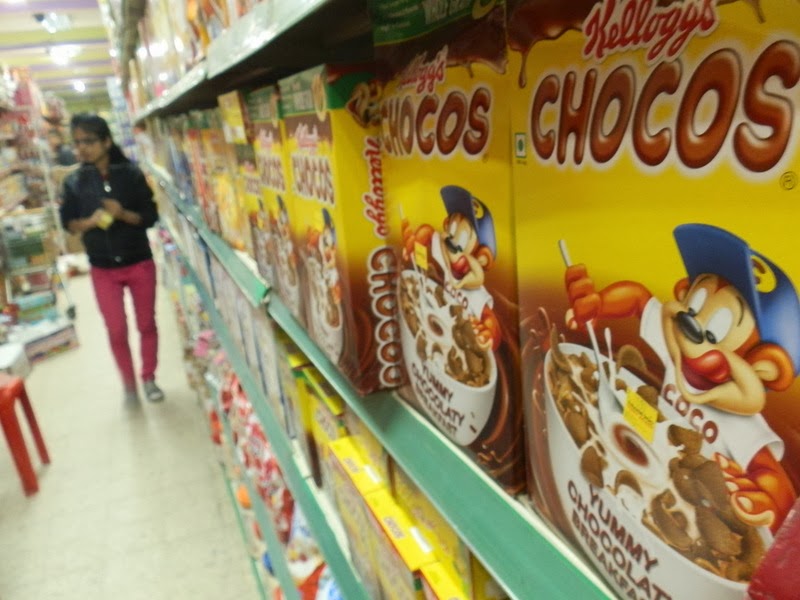
Here are more offerings to fill the kitchens of Nepal with diabetic shock whoops I mean  glee. These are found in our local Big Western Departmental Store, wherein you can find entire aisles dedicated to the use of "Choco" as a prefix.


99.4 percent pure Glucose. And such a happy,
healthy family. Well, happy anyway.  


This store is called Salesway, like Safeway but harder to pronounce. Try saying it fast: Salesway, Salesway, Salesway. Bet you can't. This Tang-packed tongue-twister of a shopping destination serves mainly the upper class, although people like to use the interesting euphemism "middle class," which to me implies "people in the middle" and so ought to have something to do with the average person, but instead seems to have acquired a new definition and now means "People Who Can Be a New Market for Tang." If you lived here, you would go to Salesway and be glad of it, just like me. Wow! Corn syrup-laden peanut butter! Just like in a 1950s bomb shelter! I think I will buy that to enjoy with my Tang and spam. Do they have it in Choco flavor?

Thanks to the wonders of google, I know that at the Salesway's pronounceable alter ego, Safeway, you could get a turkey for 59 cents a pound, so our 12-pound turkey would have cost $7. But we live a more elegant life here on the moon, because our 12-pound turkeys fly in from Australia, apparently in First Class, or possibly comes on a rocket ship with the Tang, so we get to savor it for $80 like the gourmets we are.

But what, actually, does $80 mean in Real Nepali terms? Because, see, if you're a Westerner here you may have more or less multiples of that $80 in your budget, and you might not choose to spend it on turkey, but you've got it. Somewhere. How can we, who might think Ohmigod it's $80, unbelievable, horrible, here's the $80 and ouch that hurt but put it on my credit card and yum yum, conceptualize that amount?

Well, I've got a cheat sheet. So we now interrupt this edition of The Brady Bunch Get a Sugar Rush for a ...

Nepali Home Economics Lesson


What is that 8,000 rupees in percent-of-salary terms? What would it feel like? 

Here's one benchmark. Eight thousand rupees ($80) is the monthly wage, give or take a bit, for drivers, cleaners, clerks, and teachers at small private schools -- people in jobs that elsewhere might earn an annual salary somewhere around $24,000. Yeah, it's described as minimum wage here, but lots of people earn less, so let's be real and call it low-wage or starting jobs.

Here are a few other salaries:

Teacher in a government school: 14,000 to 31,000 a month ($140 to $310).

Police officers: there's a range, but constables earn 14,830 ($148) and a senior superintendent earns about 30,000 ($300)

Doctor: 20,000 starting salary in Kathmandu, or 30,000 for specialists ($200 to $300).

First-Class Government Officer: 30,000 a month ($300). The job level is roughly equivalent, if you speak Washingtonese, to a GS-13 who brings home $90,000 or a pre-tax $7,500 a month. Other government jobs are here, along with a bit of commentary about how they, uh, enhance their incomes.

Engineer: 33,000 a month ($330) according to this site. 

This medical student was buying a kurta salwar for a friend's
wedding. The cost was 4,700 rupees -- $47 for an American,
but a fifth of the monthly salary ($250) she'll be able to earn
as an entry-level doctor in Nepal. Imagine if you had to pay
a fifth of a doctor's typical  starting salary for a party dress.
Prices are high because of the cost of material, labor,
transport costs and customs duties.
Of course it does go higher. People on this helpful site self-report salaries as high as 117,000 for a financial manager, and Nepal does have far better-paid people than that as well. Lots of them. They own cars and big houses and some are so rich they could buy turkeys for the whole neighborhood. But they're not in the "middle class" unless you love euphemisms.

On the whole, the easiest way to grasp what money means is to think of percent-of-salary terms. On that scale (which can be a math project if you're a middle-school student who somehow stumbled onto this blog!), 1000 rupees becomes $250 on the percent-of-salary or "feels-like" scale. Looked at that way, the cost of that turkey is equivalent to about $2,000. It's the whole monthly pay of a low-paid employee, or just over a third for a GS-13. That's a heck of a bird.

Pringles feel like $50 for one cylinder
Of course, Nepalis don't buy turkeys, which is an exotic gourmet import and priced to match. But people need clothing. For a budget middle-class sari or salwar kameez, a woman has to spend at least 1000 but probably closer to 1500 rupees. For a nice occasion, she needs at least 4,000. If she opts for jeans, they start at 800 Rs., and the shirt doesn't come for free.

So it's hard to get away with under $15-20 per outfit. Think $500 on the "feels like" scale. How many teachers or nurses or lawyers in the US, or even Junior League socialites, spend $500 on an outfit to wash the dishes in and $1000 for something to wear to a neighborhood party or a second cousin's wedding? But here, there's no other choice.

If you wanted some of the "luxury" processed imported foods that are increasingly found here, you might get some Tang (feels like $30 for one small packet), a one-person bag of Lay's of the type found in vending machines (feels like $10), a small roll of Oreos (feels like $20) or some instant coffee like Nescafe (feels like $30 for a micro-jar to $100 for a large jar). If you can't afford that -- and most people would consider a bag of Lay's or a roll of Oreo's a "splurge" purchase -- you'd certainly still need vegetables for dinner.


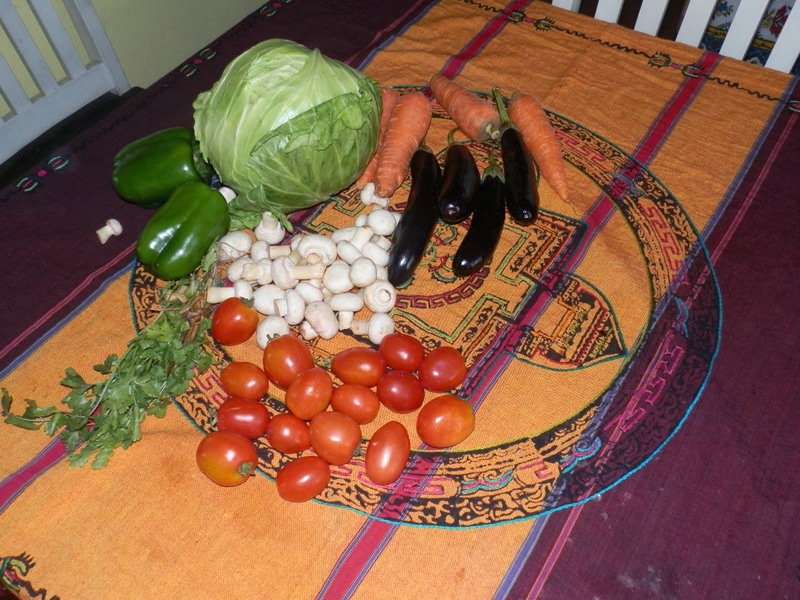
My neighborhood street stalls for veggies, where people can buy ...
this much veggies for a "feel-like" cost of about $50.
It's cheap if you say "$2.50," which is the cost for an American.
It doesn't feel cheap if you're in Nepal's real middle class.


The other day I saw an ad posted for a full-time job in an organization that supposedly provides "economic empowerment." The salary offer? 5,000 to 7,000 for someone with a Bachelor's in Business Administration. That's under the minimum wage and technically illegal, but not uncommon. I'm imagining the letter home of the newly minted college grad who gets this job.

Dear Mom and Dad, How was the harvest? I have a new job doing economic empowerment! Please send money. And rice. And lentils. By the way, have you considered raising turkeys?


This woman's total outfit, including budget-level sari, sandals, blouse 
and now-faded shawl, probably cost 2000 Rs ($20).  
That's roughly equivalent, in "feels like" terms, to wearing $500 worth of clothes.
She does not look like a socialite.